
How to Set Up a Training Program for a Consulting Firm
Elena runs a 16-person management consulting firm in Austin. Last fall she brought on two new associates — both sharp, both with meaningful firm experience at recognizable companies. She skipped the formal training sequence she'd built for junior hires, reasoning that she'd be wasting their time. Twelve weeks later, a client flagged inconsistencies in how her team structured deliverables. Two consultants had been operating from two different engagement frameworks on the same project. Neither was wrong exactly. Neither was Elena's.
The friction cost her firm one uncomfortable client call and about three weeks of re-alignment work. The root cause wasn't a skills gap. It was a training gap — specifically, the absence of any structured program that taught new consultants how her firm operates, not just how consulting operates in general.
A consulting firm training program is a structured sequence of role-specific modules covering your methodology, internal tools, compliance requirements, and client-facing protocols — delivered in a defined order, tracked for completion, and renewed on a defined schedule for anything that changes annually. It's not remediation for junior staff. It's alignment for everyone.
What does a consulting firm training program actually need to cover?
A consulting firm training program covers four categories: methodology training (how your firm structures client engagements), tools training (the software your team uses daily), compliance training (confidentiality agreements, data handling, anti-harassment policies, and any industry-specific obligations), and client-facing protocols (how your team communicates with clients, presents work, and handles escalations).
Most firms have informal versions of all four. A conversation during onboarding week. A shared drive with a folder called "Onboarding Resources." The problem is that informal delivery doesn't create a completion record, doesn't scale when you add your seventh consultant, and doesn't protect you when a client relationship dispute involves a claim that someone wasn't trained on your confidentiality process.
| Training category | What it covers | Recommended format |
|---|---|---|
| Methodology | Engagement frameworks, delivery standards, reporting templates | Video walkthrough + quiz |
| Tools | Project management, file naming conventions, reporting software | Reference document + attestation |
| Compliance | Confidentiality, NDA, anti-harassment, data handling | Written acknowledgment + annual renewal |
| Client-facing protocols | Presentation standards, communication guidelines, escalation process | Video walkthrough + attestation |
That table is the starting map. Before you build a single module, fill it in for your firm.
Why do consulting firms skip training for experienced hires?
The assumption is that experience substitutes for firm-specific training. It does not. An experienced consultant knows how to consult. They do not know your engagement model, your preferred tools, or the specific language your clients expect in status updates. Treating those as obvious wastes the only onboarding window you get.
The second reason is that building a training program feels large — something you'll get to after this quarter's crunch, when the firm is bigger, when things slow down. The result is a 25-person firm where onboarding still runs on a Slack message with six PDF attachments that nobody can confirm were read.
Senior hires are actually the highest-risk case. They have the most ingrained habits from prior firms. They're the least likely to ask questions about your way of doing things because they already feel confident. And they're the most likely to bring methodology divergence directly into client engagements before anyone notices.
Step 1: Map what your consultants actually need to know
Before you build anything, spend 30 minutes listing everything a new consultant needs to know to operate independently within their first 90 days. Group the items into the four categories above.
Most consulting firms find this produces 15–25 distinct training items. That is not 15–25 separate videos — several can be short written acknowledgments or a single reference document with a checkbox at the end. The goal at this stage is a map, not a curriculum.
Flag anything with a compliance dimension: a policy with legal implications, a document that needs annual re-acknowledgment, or a regulatory requirement tied to your clients' industries (data privacy regulations, professional licensing standards, certain AML obligations for firms advising financial-services clients). Those items need tracking and renewal, not just one-time delivery.
Step 2: Choose formats that match each training type
Not every training item needs a video. The format should match the purpose.
A policy acknowledgment — confidentiality, data handling, anti-harassment — works as a written document with an e-signature or timestamped checkbox. It needs to be dated, version-tracked, and exportable when a client or regulator asks for it. A walkthrough of your engagement methodology works better as a short screen recording than a written guide, because the goal is understanding process flow, not confirming receipt of text. Quizzes work well for anything where you need to verify comprehension, not just delivery.
The practical rule: if the training item creates legal or compliance exposure, use a format that produces an auditable record. Attestation and e-signature do that. A Slack message does not.
Step 3: Build your training packets
Group your training items into sequences. Most consulting firms need two: a new-hire packet for consultants joining the firm, and an annual compliance packet for everyone on renewal.
The new-hire packet covers the full map. Sequence it logically — policy acknowledgments first (these create your compliance baseline), then methodology training (this shapes how they engage with clients), then tools training (this handles day-to-day operations). Don't dump all 20 items on day one. Build a sequence that spreads over the first two weeks so each piece has time to land.
The annual compliance packet covers only the items requiring periodic re-acknowledgment: typically confidentiality policy, data handling standards, anti-harassment policy, and any industry-specific compliance items. If your firm advises clients in regulated industries, some of those renewal dates are not optional.
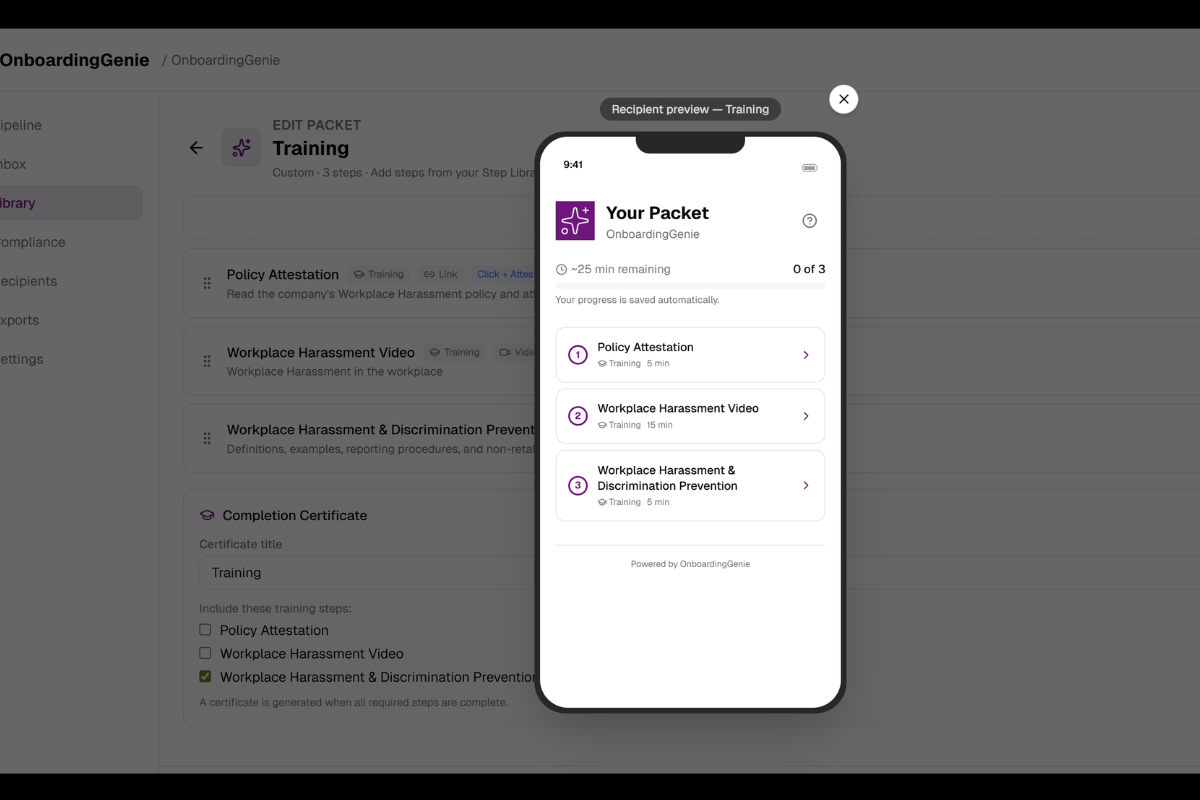
Step 4: Set up delivery and completion tracking
Training that isn't tracked isn't training — it's a suggestion. Delivery tracking means you have a record of who received each module, when they completed it, what their attestation or quiz score was, and which version of each document was in force at completion time.
This matters when: a client engagement goes sideways and your confidentiality procedures are questioned; a new regulation requires you to demonstrate staff training; an employment dispute involves a consultant who claims they weren't informed of a specific policy. The difference between a documented training record and "we told them in onboarding" is the difference between a defensible position and a painful one.
The mechanism doesn't need to be elaborate. A platform that sends a packet link, records completion timestamps, and exports a clean PDF of the completion record covers what most small consulting firms need. A spreadsheet where you manually check off "sent the PDF" is not a training record.
Step 5: Schedule renewals for compliance-related training
The annual compliance packet matters because regulations change, firm policies update, and the documentation of ongoing training sometimes determines audit outcomes.
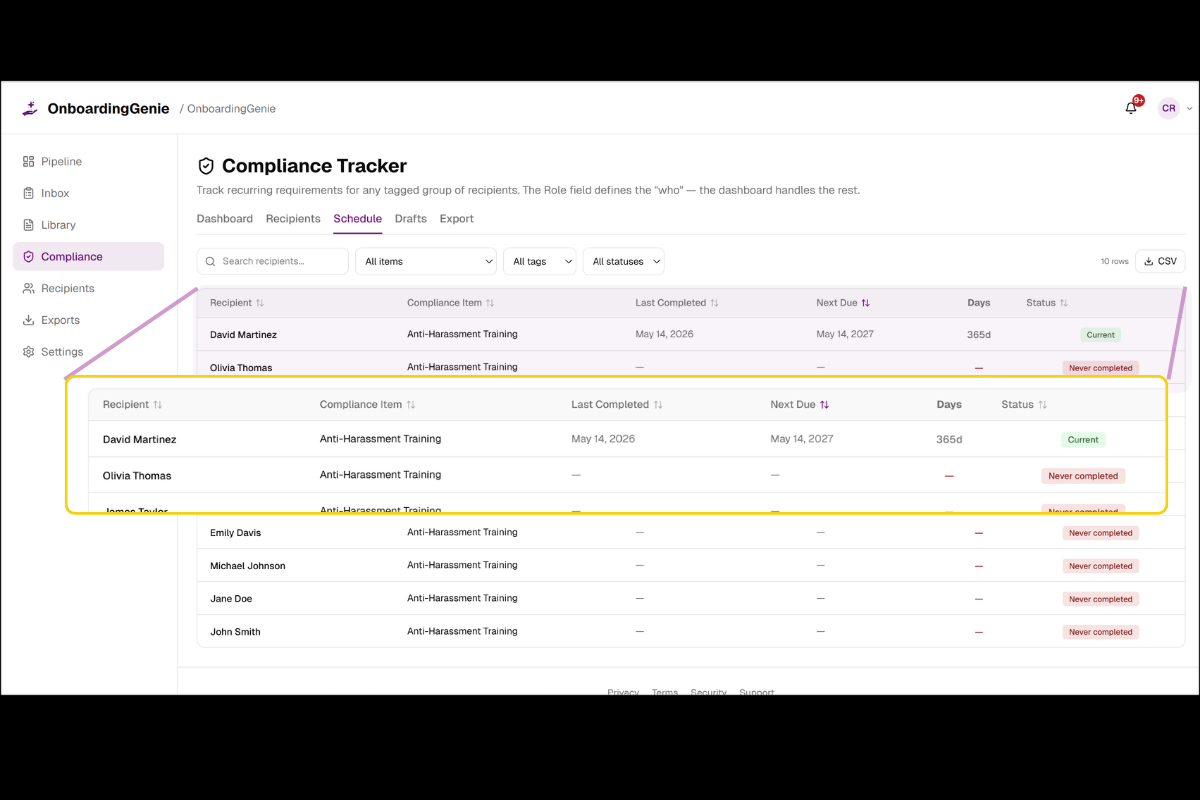
Set renewal dates at onboarding, not later. If your confidentiality policy requires annual re-acknowledgment, schedule it at the 12-month mark from each consultant's start date — or on a fixed calendar date for the whole team if cohort renewals are easier to manage. Either approach works. What doesn't work is remembering to schedule renewals after they've already lapsed.
For consulting firms advising clients in financial services, healthcare, or legal verticals, some compliance training requirements are tied to those industries' renewal schedules. Build those into your calendar at setup rather than discovering them at audit time.
What most consulting firms get wrong
The most common mistake is building the training program once and treating it as done. Your methodology evolves. Tools change. Compliance obligations shift as your client industries shift. A training packet from three years ago that nobody has reviewed is a liability you haven't identified yet.
The second mistake is treating training and onboarding as the same event. Onboarding happens in the first week — access, introductions, equipment. Training happens over the first 90 days and continues annually. Conflating them produces a firm where everyone got a folder of PDFs on day one and nobody received actual training.
The third mistake is skipping the client-facing protocol training until "after the consultant is up to speed on the work." Client-facing protocols are the work, for a consulting firm. The moment a new consultant sends their first client email, they're representing your standards. That's not the place to discover alignment gaps.
What this looks like in OnboardingGenie
When I built the training module, I had this use case in mind: a small professional services firm with a handful of new staff per year that needs structured, trackable training without the overhead of a full learning management system.
You build a training packet the same way you'd build any onboarding packet — add steps, choose types (attestation, quiz, video reference, or standard e-sign), and sequence them. Send it as a single link. When your consultant completes it, you have a timestamped completion record for every step, exportable as a PDF for your files.
The compliance tracking side handles renewals automatically — you set the recurrence at setup, and the platform drafts renewal packets at the scheduled interval. For a 20-person consulting firm tracking confidentiality acknowledgments and methodology re-attestations across the whole team, that's the difference between a functioning compliance program and a spreadsheet of things you're hoping haven't lapsed.
You can see how training packet delivery and completion tracking work in practice, or take a look at how ongoing compliance tracking connects to annual renewals for the full picture.
Frequently asked questions about consulting firm training programs
How long should a new consultant's training take to complete?
Most consulting firm training programs take 2–4 hours of active completion time, spread across the first two weeks. Policy acknowledgments take minutes; methodology videos and quizzes take longer. Spreading the sequence over two weeks gives each consultant time to absorb each component before moving to the next rather than treating the whole program as a day-one checklist.
Should contractors get the same training as full-time consultants?
Training requirements for 1099 contractors differ from employees, and what's formally required depends on your contracts, your clients' requirements, and the industries you serve. The practical case for training contractors is straightforward regardless: a contractor advising your clients on your behalf represents your firm, and misalignment on methodology or client-facing protocols affects your business regardless of classification. At minimum, contractors who work directly with clients should acknowledge your confidentiality and data handling policies. Full methodology training is worth including for any contractor whose work is regularly client-facing.
What compliance training is legally required for consulting firms?
The baseline most consulting firms need: annual re-acknowledgment of confidentiality policy, data handling standards, and anti-harassment policy. Beyond that, it depends entirely on what industries you serve. Consulting firms advising financial services, healthcare, or legal clients will often find that their client contracts — or their clients' compliance programs — impose additional training obligations on them. A compliance attorney familiar with your client verticals is the right person to map exactly what applies to your firm.
How often should the training program itself be reviewed and updated?
At minimum annually. Anytime your methodology changes significantly, a major tool is adopted, a compliance policy is revised, or your client base shifts into a new industry vertical, that's a trigger to review and update the relevant training modules. Treating the training program as a living document rather than a one-time project is what separates firms with effective training from firms with training that quietly goes stale.
Can I build a consulting firm training program without expensive LMS software?
Yes. A full learning management system is designed for organizations training hundreds of people across many departments. A small consulting firm needs completion tracking, attestation records, quiz delivery, and annual renewal scheduling — all of which are available in lightweight platforms built for small professional services firms at a fraction of the cost.
Building a training program sounds like a project. It is — once. After that, it runs. Start with a free OnboardingGenie trial and have your first consulting firm training packet structured and sent within the hour.
Founder, OnboardingGenie