
The Role of Training in Consultant Onboarding (And Why Experience Isn't a Substitute)
James hired a senior consultant with 12 years of Big Four experience. He did exactly what most consulting firm founders do when they bring on a high-caliber hire: he handed over the client list, introduced him to the project management tools, and assumed the rest would sort itself out. Fourteen weeks later, a long-term client pulled James aside on a call. The deliverables had been good, she said, but the engagement had a different feel. Two methodologies, two communication styles, two implicit standards for what "final" meant — operating in parallel on the same account.
The senior consultant wasn't doing anything wrong. He was doing what he'd always done at a firm that had its own way. James had never told him what James's way was.
Training in consultant onboarding is the structured process of teaching new consultants — regardless of experience level — how a specific firm operates: its engagement methodology, client communication standards, compliance obligations, and internal tools. It is distinct from general consulting skills, which experienced hires already have. And it is the component of onboarding that consulting firms most reliably skip, for the most predictable reasons.
What is the role of training in consultant onboarding?
Training in consultant onboarding serves three distinct functions that are easy to conflate and important to keep separate: alignment, compliance documentation, and ongoing professional development.
Alignment is the immediate function. It closes the gap between how a consultant has worked elsewhere and how this firm works. Alignment training covers engagement methodology, deliverable standards, client-facing communication protocols, and the specific tools the firm uses. For an experienced hire, this is mostly about unlearning defaults — not because their prior approach was wrong, but because your firm has made different choices and clients expect consistency.
Compliance documentation is the legal function. Every professional services firm has obligations that require documented, auditable evidence of training: confidentiality policy acknowledgment, data handling standards, anti-harassment training, and depending on the firm's industry, potentially more. The documentation is what protects the firm when a dispute arises or an audit happens, not the training itself.
Ongoing professional development is the long-term function — not typically addressed in initial onboarding, but connected to it. Firms with strong onboarding training programs are also the firms that maintain continued development programs, because the same infrastructure that supports initial training supports renewal and expansion.
Why is training the part that gets cut from consultant onboarding?
Training gets cut from consultant onboarding for three reasons, and they're almost universal across firms of 5–50 people.
The first is the experience assumption. When a new hire comes in with 10 or 12 years on the job, training feels unnecessary — even condescending. The hire doesn't push back on the absence of training because they're confident. The hiring firm doesn't schedule it because they trust the resume. Nobody raises the issue until a misalignment shows up in client work, by which point it's already expensive.
The second is the urgency trap. Consulting firms hire when they have too much work. The moment a new consultant arrives, there's a billable engagement waiting. Every hour spent on training is an hour not spent on client work — at least in the short-term accounting. The long-term accounting, where one client relationship damaged by a misaligned consultant costs more than a week of training time, doesn't make it onto the immediate spreadsheet.
The third is the infrastructure gap. Running a training program requires building one first. Most small consulting firms don't have a structured training program — they have a conversation during the first week and a shared drive with reference documents. Building the program is the project that nobody has time for, so it stays undone until a concrete failure creates the motivation.
What types of training belong in consultant onboarding?
Consultant onboarding training covers four distinct areas that shouldn't be merged into a single undifferentiated "orientation."
Methodology training is the highest-leverage piece and the most overlooked. Every consulting firm has — or should have — a documented approach to structuring engagements, framing findings, and presenting recommendations. A new consultant, however experienced, needs to learn your version before they're in front of a client. This is typically delivered as a combination of reference documentation and a walkthrough, and it should include actual examples from past engagements.
Tools and process training covers the software, templates, and file structures the firm uses daily. This is the most straightforward category — new consultants expect to learn new tools — but it needs to be structured rather than ad hoc. "Ask anyone if you have questions" is not a training program.
Compliance training is the most legally consequential category. It includes policy acknowledgment (confidentiality, data handling, conflict-of-interest, anti-harassment), any client-specific compliance requirements the firm has taken on, and industry-specific obligations if the firm serves regulated-industry clients. This category requires documentation: a dated, version-tracked acknowledgment record for each policy, not a casual conversation.
Client-facing protocol training covers the firm's specific standards for client communication: report formats, presentation style, escalation procedures, and communication frequency norms. This is the category that James's senior hire was missing when the client noticed inconsistency.
| Training type | What it covers | When in onboarding | Format |
|---|---|---|---|
| Methodology | Engagement structure, frameworks, deliverable standards | Week 1–2 | Video walkthrough + quiz |
| Tools and process | Software, templates, file naming, reporting tools | Week 1 | Reference doc + attestation |
| Compliance | Policies, acknowledgments, annual-renewal items | Day 1–3 | Written attestation + e-sign |
| Client-facing protocols | Communication standards, presentation norms, escalation | Week 2 | Video + attestation |
How should training be sequenced in the onboarding timeline?
Training should be sequenced in the onboarding timeline the way a foundation is laid before framing: compliance and policy acknowledgments first, methodology second, tools third, client-facing protocols last.
The compliance-first sequence isn't arbitrary. Policy acknowledgments create a dated record from the beginning of employment. If a data handling issue or confidentiality question arises six months later, the record shows what the consultant acknowledged, in what version, on what date. Starting with methodology training and leaving compliance until "whenever there's time" means the compliance record is incomplete for the period between start date and the eventual training session.
Methodology training comes second because it's the highest-leverage piece and needs time to absorb before the consultant is actively on engagements. Compressing methodology training into a single day-one overview is common; it's also why day-one overviews don't stick. Spreading methodology training across the first two weeks — initial overview, then deeper sessions on specific engagement types — produces better retention and more consistent application.
Client-facing protocol training belongs last because it's best absorbed in context. A consultant who has seen the tools, absorbed the methodology framework, and participated in one internal project review has the context to understand why specific communication standards exist. That same training delivered on day one is often treated as general guidance that gets overwritten by experience-driven defaults.
What happens when training is missing from consultant onboarding?
The consequences of missing training in consultant onboarding fall into two categories: client-visible and compliance-invisible.
Client-visible consequences are the ones James experienced: inconsistent deliverable quality, mismatched communication styles, divergent methodologies in the same engagement. These are painful and visible, but they're also fixable once identified. The cost is the re-alignment work plus any client relationship repair required.
Compliance-invisible consequences are quieter and potentially more serious. A consultant who was never formally trained on your confidentiality policy doesn't have a dated acknowledgment on file — which means in a dispute, you can't demonstrate training occurred. A consultant who wasn't trained on your data handling standards becomes a liability if a client's data is mishandled, even inadvertently. These gaps don't surface until an incident or an audit creates the pressure to find them.
The pattern I've observed consistently: firms that skip training during onboarding tend to discover the gap at the worst possible moment — a client escalation, a compliance review, or an employment dispute. The training program that wasn't built in Week 1 gets built in emergency mode after the incident, which is more expensive and more disruptive than building it in Week 1 would have been.
This is the same dynamic described in the context of compliance programs generally — the failure mode isn't negligence, it's a process that worked right up until it didn't. The compliance documentation patterns that protect small professional services firms apply directly to consulting firm training programs, because training acknowledgments are compliance documentation.
What does a complete consultant onboarding training program look like?
A complete consultant onboarding training program has five properties: it's documented (written down, not in someone's head), it's sequenced (delivered in the right order, not all on day one), it's tracked (completion records exist for every step), it's version-controlled (policies are dated so you know which version was acknowledged), and it's renewable (compliance items are scheduled for annual re-acknowledgment rather than assumed to be permanent).
Most small consulting firms have one or two of these properties. They have documentation — a folder of policies. They have some tracking — a checklist someone completes manually. What they typically lack is the combination of version control and renewability that makes the program defensible over time rather than just at the moment of hire.
The infrastructure for that level of rigor doesn't require an enterprise learning management system. It requires a platform that sequences and delivers training modules, captures timestamped completion records, and schedules renewals for the items that require them. For a 15-person consulting firm, that infrastructure costs less per month than a single billable hour.
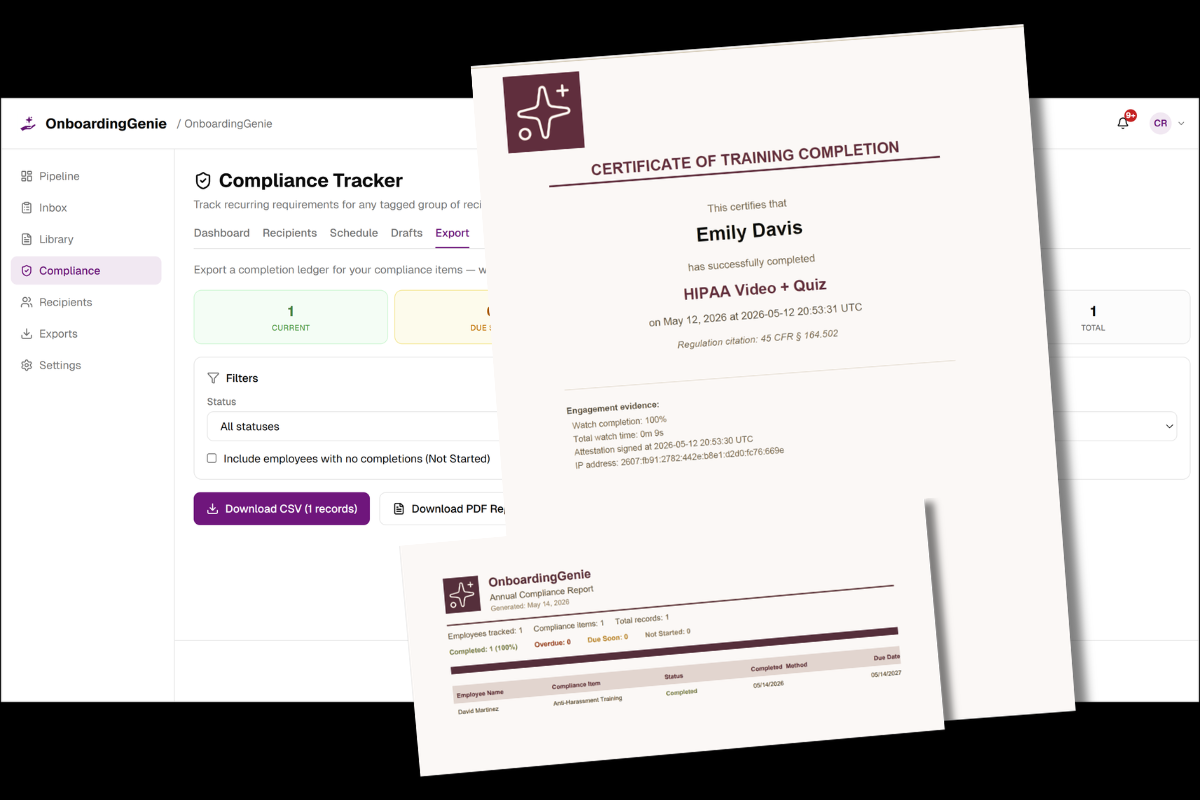
If you're thinking about how to structure the training component of your consultant onboarding, the practical guide to setting up a consulting firm training program covers the step-by-step build. And if your firm advises clients in regulated industries, the compliance tracking framework for professional services connects the training documentation to the broader ongoing compliance picture.
Frequently asked questions about training in consultant onboarding
How is consultant onboarding training different from general employee onboarding?
Consultant onboarding training is more heavily weighted toward methodology alignment and client-facing standards than typical employee onboarding. Most employee onboarding focuses on policy compliance and role-specific task training. Consultant onboarding needs to include the engagement framework, communication protocols, and deliverable standards that define how the firm operates in front of clients — because that's where misalignment does the most damage.
Should experienced consultants complete the same training as junior hires?
Yes, for compliance and methodology training. The format can adapt — an experienced consultant may move through methodology training faster, and some tools training may be unnecessary if they're already proficient — but the compliance acknowledgments and client-facing protocol training are not optional based on seniority. Experienced hires are actually the highest-risk case for methodology misalignment, precisely because they have strong defaults from prior firms.
How long should consultant onboarding training take?
For a well-structured program, the active training time is typically 3–6 hours spread across the first two to three weeks — not a single day of onboarding sessions. Compliance policy acknowledgments take 20–30 minutes. Methodology training, done properly with a combination of walkthrough and structured review, takes 2–4 hours. Client-facing protocol training adds another 30–60 minutes. Spreading these across the first two weeks significantly improves retention over compressing them into day one.
What's the difference between training in consultant onboarding and a performance review?
Onboarding training establishes the baseline: what the firm expects, how it operates, and what the consultant has formally acknowledged. Performance reviews assess execution against that baseline over time. The two are related — a documented training program gives you the reference point for performance conversations — but they serve different functions and happen at different times.
Does remote consultant onboarding require different training approaches?
The content of the training is the same; the delivery mechanics change. Remote consultants need more structured training because they don't absorb methodology and culture through proximity the way in-office hires do. The absence of hallway context for remote consultants makes explicit, structured training more important, not less. Video walkthroughs and clear reference documentation replace the in-person observation that in-office environments provide informally.
James's 12-year veteran didn't need basic consulting training. He needed to learn James's firm. That's a 2-hour training sequence, not a week-long program. Set it up in OnboardingGenie and send it before your next hire's first client call.
Founder, OnboardingGenie